Beginner's guide · Chapter 4 of 6
How to pick mushrooms without harming the forest
What you put in the basket is only a small part of the mushroom. How you pick it decides whether that corner of the forest will give mushrooms again next year.
What you see is only the fruit
The fungus lives underground, as mycelium: a network of very fine threads spreading through the soil, sometimes for decades, linked to the roots of the trees. What pokes out is its fruit, which appears for a few days to release spores and then disappears. Picking that fruit does not kill the fungus, just as picking an apple does not kill the apple tree. What does harm it is turning over the soil, trampling it again and again, or taking everything and leaving nothing.
Cut or twist
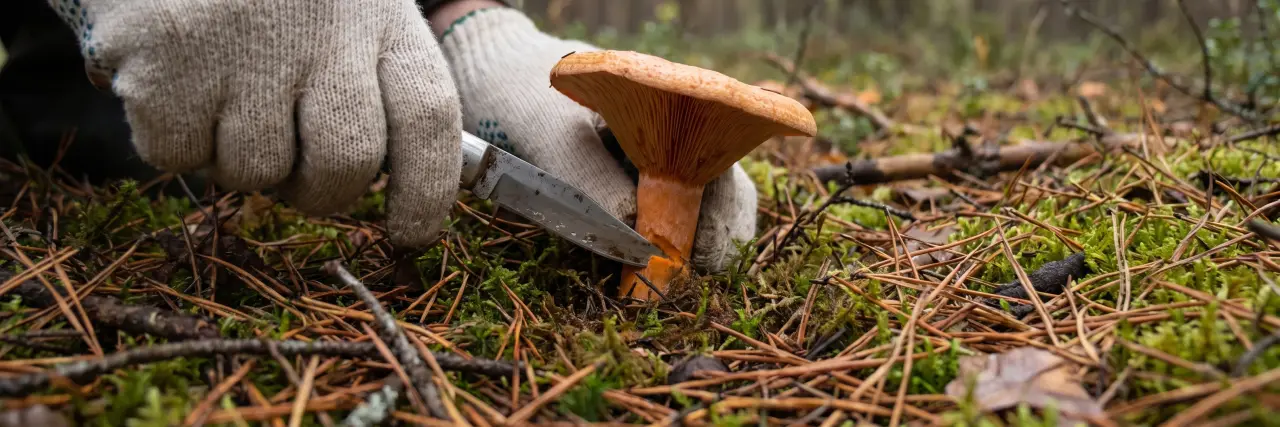
Both ways are fine. You can cut the mushroom at the base with the knife or ease it out by twisting it gently, without pulling up soil. What matters is what you do next: cover the hole with the soil and leaves that were there, so the mycelium is not left exposed to dry out.
There is one exception: if you take a mushroom you do not know so someone can identify it, take it out whole, base included. Very often what decides whether a mushroom is edible or deadly is right there, in the part that stays buried.
Leave the small ones and the old ones
Very small mushrooms still have to grow, and they are also harder to identify. Old, open ones are no longer good to eat, but they are shedding spores: leaving them is sowing. Take the ones at their best and only those you will eat. There is no need to reach the limit.
Do not turn over the soil
No rakes, and no kicking up the moss or the leaf litter to see what is underneath. That layer is the mycelium's home. Walk carefully, do not trample the same ring again and again and, when you can, use the paths.
The ones you leave, leave standing
Kicking over mushrooms that are not edible is a habit as widespread as it is pointless. Poisonous ones have their role in the forest too: they break down wood and leaf litter, feed animals and insects and help the trees. And whoever comes after you may want to see them or photograph them.
Respect the forest and those who live from it
- Leave gates as you found them, and respect livestock.
- Park without blocking tracks or paths; neighbours and emergency services use them.
- Take your rubbish with you, and if you can, some that is not yours.
- No fires, and careful with cigarettes: a dry autumn burns too.
- If there are signs for a hunt, respect them: for your safety and everyone's.