History, regions, cooking and safety
Mushrooms in Spain: the story of a hunt
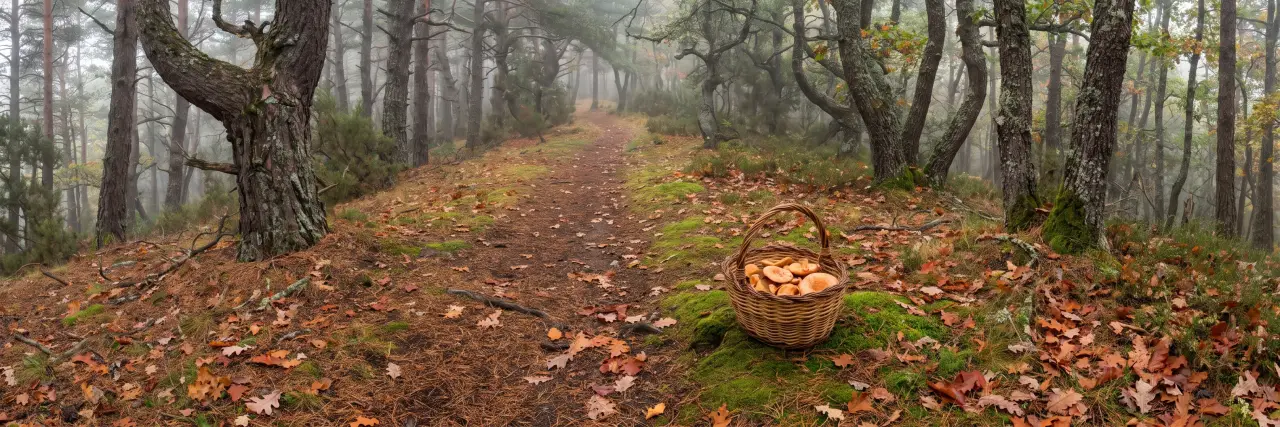
Heading into the woods with a basket after the rain is a habit older than the paths we walk today. In Spain it has been a passion in some regions and a source of suspicion in others, food for shepherds and a luxury on the plate, and every region lives it its own way. This is its story, and what you should know before you fill your basket.
A story as old as the forest
Mushrooms have been with people since long before there were recipes. Ötzi, the man who died in the Alps some 5,300 years ago and was found frozen in a glacier, carried two fungi: one for lighting fires and another that, researchers believe, he probably used as a remedy. In Spain, at the Selva Pascuala rock shelter in Villar del Humo (Cuenca), a cave painting some six thousand years old shows figures that some scholars read as mushrooms.
The Romans adored them. Their favourite was the oronja, the mushroom that still bears the name of the Caesars, Amanita caesarea. They cooked it in vessels kept only for it, and Pliny the Elder already warned that some mushrooms kill. Tradition has it that Emperor Claudius died in the year 54 after eating a dish of mushrooms poisoned on purpose.
For centuries, across much of rural Spain, mushrooms were food for the poor and for shepherds, or something viewed with suspicion, the stuff of witches and poisons. Only the few that were eaten without fear had names of their own: the St George's mushroom in the north, the saffron milk cap in the pine woods, the king oyster mushroom in the fields. The modern hobby was born in the 20th century with the first mycological societies and their autumn exhibitions, where people learnt to tell the edible from the rest.
Today, every autumn, hundreds of thousands of people head into the woods to look for mushrooms. There are villages that live off them for a few weeks a year, food festivals, seasonal markets, forests where you need a permit, and even a tourism of its own, mushroom tourism, which fills rural guesthouses as soon as it rains.
Mushroom-loving Spain and mushroom-fearing Spain
In the 1950s the Wassons divided the peoples of Europe in two: the mycophiles, who love mushrooms and know them by name, and the mycophobes, who fear and avoid them. For a long time Spain was both at once. Catalonia and the Basque Country have always been mycophiles: there, going mushroom hunting is as normal as going to the beach in summer. Much of Castile, Andalusia and Galicia were far more wary, and for decades they let others gather the best porcini in their forests to sell them abroad.
The line has faded. Today people hunt and eat mushrooms everywhere, and each region keeps its favourite species, its names and its ways of cooking them.
Catalonia, the land of the boletaires
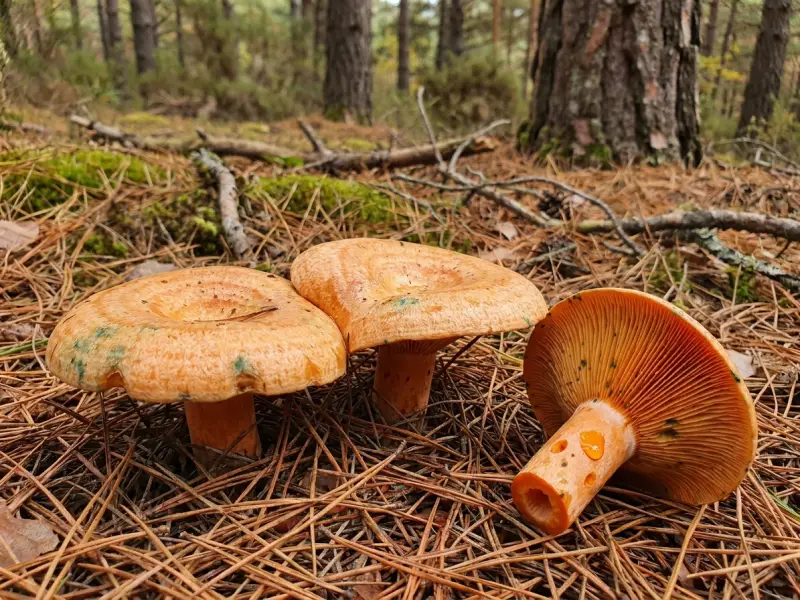
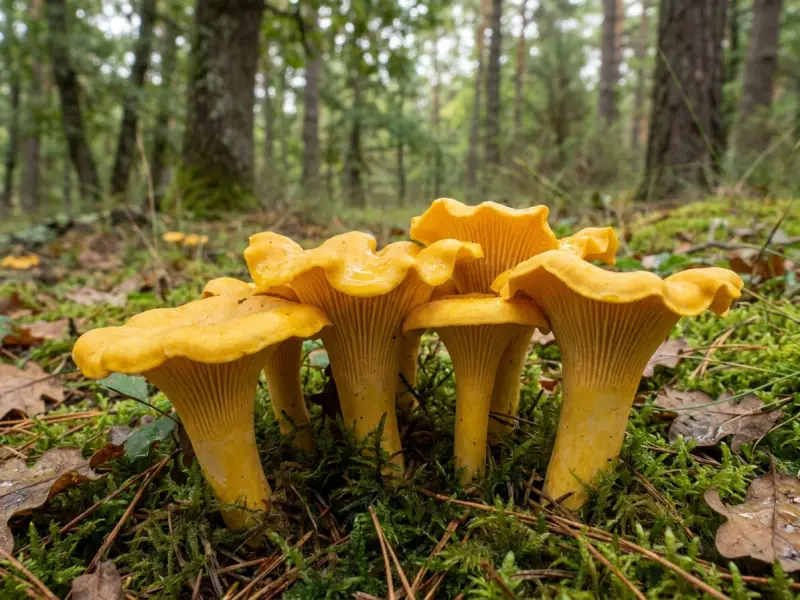
In Catalonia, «anar a buscar bolets», going mushroom hunting, is almost a national sport. On autumn weekends the roads of the Solsonès, the Berguedà and the Ripollès fill with cars parked on the verge and people carrying baskets. The queen is the rovelló, the saffron milk cap, but the list of favourites is long: the cep (porcini), the camagroc (yellowfoot), the rossinyol (chanterelle), the fredolic, the llenega and, in spring, the múrgola (morel) and the moixernó.
Few things sum up the Catalan autumn better than rovellons grilled with garlic and parsley, or stewed with botifarra sausage. The markets of Vic and Barcelona's Boqueria sell them in season, and many districts hold their own mushroom festival.
The Basque Country and Navarre: the cult of the perretxiko
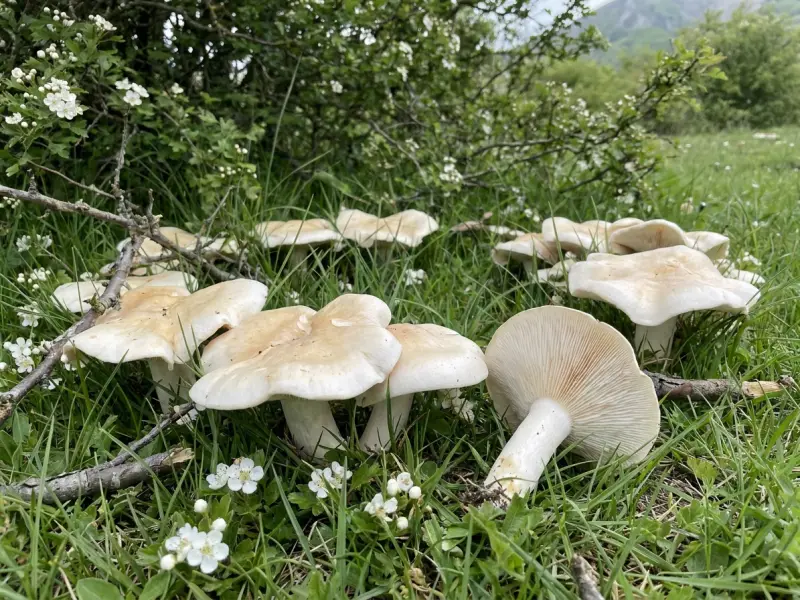
In the Basque Country the mushroom that marks the calendar comes up in spring: the perretxiko, the St George's mushroom, named because it appears towards the end of April, around the saint's day. The first of the year fetch luxury prices, and scrambled eggs with perretxikos is almost a ritual. In autumn the hongo, as porcini are called there, takes over, cooked on the griddle, scrambled with eggs or alongside meat and fish.
Navarre shares the passion and has the forests for it: the Irati beech forest, one of the largest in Europe, the Urbasa range and the Baztan valley, where beeches and oaks shelter porcini, chanterelles and black trumpets.
Mushrooms in Castile and León: pine woods of porcini and saffron milk caps
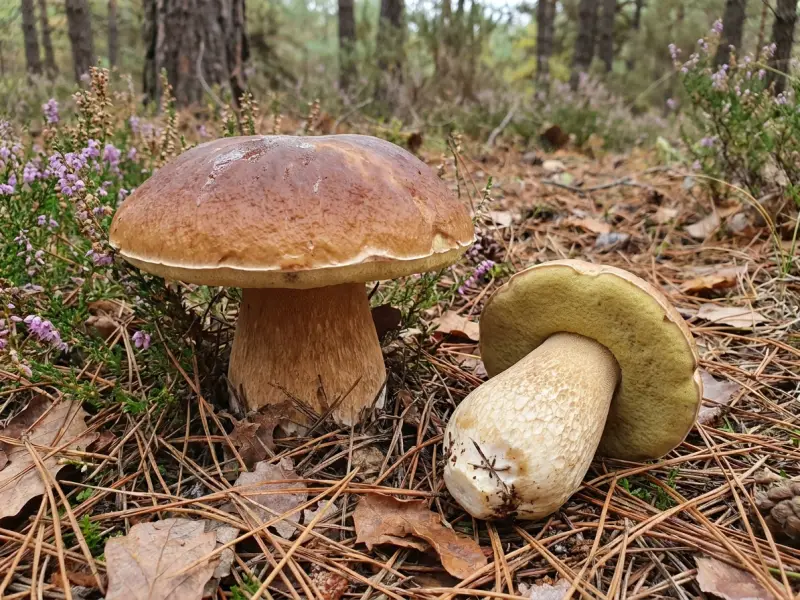
Soria turned mushrooms into part of its identity. The pine forests of its Pinares district, around Covaleda, Duruelo, Navaleno and San Leonardo, yield porcini and saffron milk caps in abundance, and they were among the first forests in Spain to regulate picking with permits, so that the forest could withstand the enthusiasm. Today many forests in Castile and León are regulated: you get the permit, you respect the limit, and the villages benefit from what their forest gives.
Burgos, Segovia and León complete the map, with the charbonniers of the pine woods, the king oyster mushrooms of the high moors and the St George's mushrooms of the meadows in spring. In Castilian cooking, porcini are eaten griddled with a drizzle of oil or scrambled with eggs, and saffron milk caps stewed with potatoes are a village dish of a lifetime.
Aragon, between robellones and black truffle
In Aragon the saffron milk cap is called robellón, and in autumn it is sought in the pine woods of the Pyrenees and the ranges of Teruel. In spring the Pyrenean valleys give morels and St George's mushrooms, and mushrooms find their way into dishes with lamb or rice.
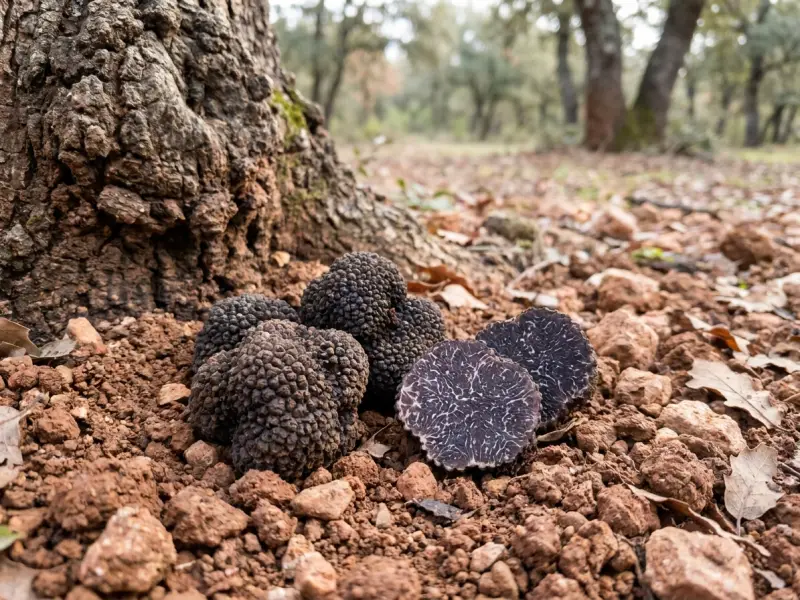
But Aragon's jewel hides underground. The province of Teruel, with Sarrión at its head, is one of the largest black truffle producing areas in the world, thanks to its plantations of truffle oaks. In winter, truffle dogs head out at dawn and the truffles are sold at markets and fairs such as the one in Graus, in Huesca. A fried egg with grated truffle is enough to understand the fuss.
Gurumelos and tanas: the mushrooms of the dehesa in Extremadura and Andalusia
In the south-west the best-loved mushroom comes up in spring: the gurumelo, which breaks through the sandy soil among rockroses and holm oaks in Huelva, Seville and Badajoz. It sells at the markets for a fortune and is eaten above all scrambled with eggs or stewed. It is also a mushroom that demands a great deal of experience, because it has deadly relatives: further down, in the section on safety, we explain why.
In autumn, the chestnut and holm oak woods of Extremadura give tanas, as the Caesar's mushroom is called there, the very mushroom of the Caesars that the Romans loved.
Mushrooms in Galicia and the northern coast: from suspicion to export porcini
For a long time Galicia was mycophobic: its oak and chestnut woods produced first-class porcini that hardly anyone ate, and for decades much of them was gathered to be sold to Italy and France. That has changed. Today cogomelos, as mushrooms are called in Galician, have their festivals, their trails and their place in the kitchen, and in Lugo and Ourense autumn smells of chestnuts and porcini.
Asturias and Cantabria share that damp landscape of beech, oak and chestnut, with chanterelles, trumpets and porcini, and a following that grows every year.
The southern plateau and the east: the king oyster mushroom and inland pine woods
In the fields of Castilla-La Mancha, Madrid and inland Valencia, the mushroom with the longest tradition is the king oyster mushroom, which grows in autumn by the roots of field eryngo, on waste ground and fallow land. The Serranía de Cuenca and the Madrid mountains add saffron milk caps and porcini in their pine woods, and in northern Castellón and inland Valencia people look for the rebollón and the esclata-sang, the local saffron milk caps, which end up in mountain rice dishes and stews.
Cooking mushrooms: from forest to frying pan
Spanish mushroom cooking is simple, because a good mushroom does not need much. Griddled with garlic and parsley, scrambled with eggs, stewed with potatoes, in rice dishes or alongside autumn game: partridge, wild boar or roe deer. Truffle is grated raw over eggs, potatoes or a good rice, and very little is enough.
The rule is always to cook them well: almost no wild mushroom should be eaten raw, and some, such as morels, are toxic if not cooked. To keep them, the safest ways are drying, as is done with porcini, which gain aroma, or sautéing and freezing them. Home-made preserves in oil carry a risk of botulism unless they are made with great care.
How to pick mushrooms without harming the forest
If you are just starting, there is a step-by-step guide for your first outing. The essentials, in short: the forest has owners and has rules. Each autonomous region, and sometimes each town council, decides whether you need a permit, how many kilos you may pick a day and where it is forbidden. Before you go, find out what applies in the area: in many forests in Castile and León, for example, you cannot pick without a permit.
- A basket, never a bag. In a wicker basket mushrooms breathe, do not get crushed and drop their spores as you walk. In a plastic bag they sweat and spoil.
- A knife, and care. Cut the mushroom at the stem or twist it out gently, and cover the hole. Never use rakes: they wreck the mycelium, which is what will give mushrooms in the years to come, and in many places they are banned.
- Leave the small ones and the old ones. The first still have to grow and the second have to shed their spores. Take only what you will eat.
- Do not mix. If you pick one you do not know so that someone can identify it, keep it apart: a piece of a deadly mushroom is enough to ruin the whole basket.
- Clean them in the forest. Brush off the soil and leaves there and then; they will arrive in better shape and the forest keeps what is its own.
- Look after yourself. Tell someone where you are going, carry a charged phone and do not lose your bearings while staring at the ground. In autumn the hunting season overlaps: if you see signs for a hunt, respect them, and wear something brightly coloured.
Poisonous mushrooms: what you need to know before you eat them
Every autumn there are serious mushroom poisonings in Spain, and some are fatal. They almost always have the same origin: someone who thought they knew a mushroom and got it wrong. That is why the golden rule is a single one: only eat a mushroom you can identify with complete certainty. At the slightest doubt, throw it away. In autumn, mycological societies hold open sessions to identify what people bring back from the woods, and they are the best school there is.
The ones that kill
A handful of species cause almost all deaths. The most dangerous is the death cap (Amanita phalloides): it destroys the liver and its symptoms take hours to appear, when the poison has already done its work. Its white relatives, Amanita verna and Amanita virosa, are just as deadly. So are some small lepiotas, such as Lepiota brunneoincarnata, some mountain webcaps, such as Cortinarius orellanus, which damage the kidneys and show up days later, and Galerina marginata, which grows on wood.
The ones mistaken for the good ones
Several of the most sought-after mushrooms have dangerous doubles. We deliberately do not explain here how to tell them apart: those differences are learnt in the forest and with someone who knows, not by reading a list, and a clue misunderstood gives a confidence that kills.
- The gurumelo shares its woods and season with the deadly white amanitas.
- The St George's mushroom is confused with Inocybe erubescens, which is highly toxic, and with Entoloma sinuatum.
- The Caesar's mushroom, above all while still closed like an egg, can be confused with other amanitas, some of them deadly.
- The chanterelle has a toxic double, the olive tree mushroom (Omphalotus olearius).
- The morel is confused with false morels (Gyromitra), which are toxic.
- Porcini have relatives that make you very ill, such as Rubroboletus satanas.
Before you eat them
- Always cooked, and in moderate amounts: they are a heavy dish.
- Fresh and firm. A good mushroom that is past its best or badly kept also poisons, and it is one of the most frequent causes.
- Away from roads, industry and treated fields. Mushrooms accumulate heavy metals and whatever is in the soil.
- With caution for children, pregnant women and older people.
Myths to forget
It means nothing that a silver spoon, garlic or onion darkens when cooked with them, that the cap peels well, that snails or animals nibble them, that they smell good or that they grow on a tree. None of those tests separates the edible from the poisonous, and the death cap passes almost all of them.
If you feel unwell after eating mushrooms
Vomiting, diarrhoea or stomach pain after eating mushrooms are a reason to go to A&E, especially if they start more than six hours later: that is the sign of the most serious poisonings, which often come with a false improvement. Do not wait to see if it passes.
In Spain, call 112 or the Toxicology Information Service, +34 91 562 04 20, 24 hours a day. Keep the leftovers of the mushrooms, raw or cooked, or a photo: they help to identify the poison.
micomapa tells you where and when the forest is ready. What you take home is decided by your eye, or by the eye of someone who knows: this page is no substitute for an expert.