Black truffle: where it grows now and when
The black diamond. It grows hidden under holm oaks and Portuguese oaks on limestone soil, and only the dog knows where.
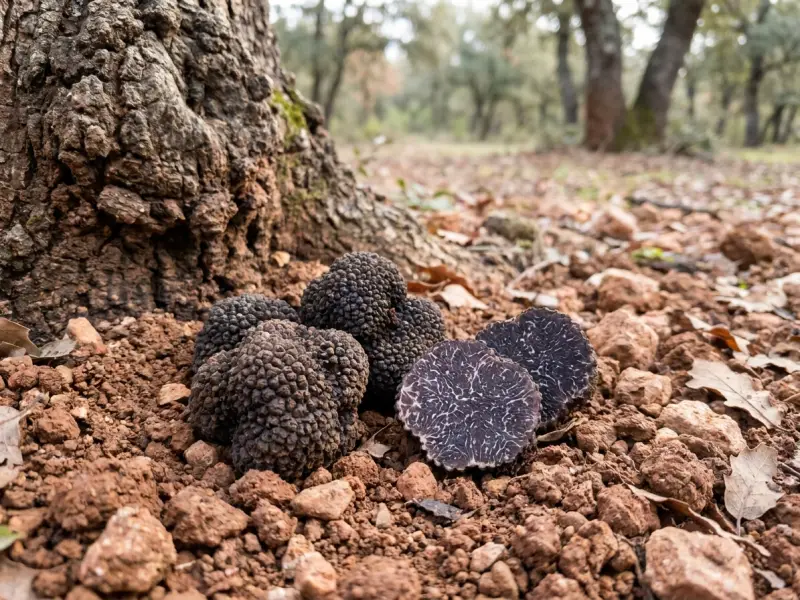
The black truffle (Tuber melanosporum) comes out from November to March, at its best in January, in woods of holm oak, Portuguese oak, downy oak and hazel, mostly in the middle mountains. It is also known as Périgord truffle.
See where it is ready this week
No area is ready for black truffles this week: the forest is still asleep.
The black truffle is the most valuable fungus in Europe and the most secret: it ripens underground, between November and March, on the roots of holm oaks, Portuguese oaks and hazels on stony limestone soils. Without a trained dog there is no way to find it, which is why its grounds are guarded like gold.
Its year is decided by the summer storms and sealed by a wet autumn and a winter without hard frosts. micomapa follows the natural truffle areas, not the plantations, and marks when the limestone soil holds the moisture and the cold the truffle needs to ripen.
What it needs to come out
First, a generous rain, the kind that soaks down to the roots. Then patience: it ripens slowly, underground, for more than a month, as long as the soil holds on to that moisture and stays cold, without freezing. If a frost, too much water or a drying wind comes in between, the flush is aborted and never shows.
Where to look
It comes out in woods of holm oak, Portuguese oak, downy oak and hazel, mostly in the middle mountains, always on limestone soils.
Black truffles by province: Álava · Andalusia: Almería, Cádiz, Córdoba, Granada, Huelva, Jaén, Málaga, Sevilla · Aragon: Huesca, Teruel, Zaragoza · Cantabria · Castile and León: Ávila, Burgos, León, Palencia, Salamanca, Segovia, Soria, Valladolid, Zamora · Castilla-La Mancha: Albacete, Ciudad Real, Cuenca, Guadalajara, Toledo · Catalonia: Barcelona, Girona, Lleida, Tarragona · Extremadura: Badajoz, Cáceres · Illes Balears · La Rioja · Madrid · Murcia · Navarra · Valencian Community: Alicante, Castellón, Valencia
Foraging for Black truffle in Álava
Álava has 72 zones with the woodland black truffles need, from 550 to 950 m. This week the woods are still asleep. Those with the most woodland are near Berrostegieta, La Puebla de Arganzón, Villanueva de Valdegovía and Berantevilla.
Where to find Black truffle in Andalusia
Black truffle spots in Almería
We count 82 zones in Almería where black truffles can come up, between 700 and 1,350 m. None is ready this week. The widest woods are near Fines, Níjar, Tahal and Nacimiento.
Black truffle in Cádiz
In Cádiz we follow 36 zones with woodland for black truffles, between 250 and 850 m above sea level. For now, no zone is ready. The zones with the most woodland lie near Alcalá del Valle, Setenil de las Bodegas, Pruna and Olvera.
Where to find Black truffle in Córdoba
Córdoba has 226 zones with the woodland black truffles need, from 300 to 700 m. This week the woods are still asleep. Those with the most woodland are near Doña Mencía, Algarinejo, Priego de Córdoba and Almedinilla.
Finding Black truffle in Granada
We count 211 zones in Granada where black truffles can come up, between 750 and 1,450 m. None is ready this week. The widest woods are near Algarinejo, Montefrío, Zagra and Moclín.
Black truffle season in Huelva
In Huelva we follow 110 zones with woodland for black truffles, between 200 and 500 m above sea level. For now, no zone is ready. The zones with the most woodland lie near El Ronquillo, Nerva, Fuentes de León and El Castillo de las Guardas.
When to look for Black truffle in Jaén
Jaén has 287 zones with the woodland black truffles need, from 450 to 1,300 m. This week the woods are still asleep. Those with the most woodland are near Castillo de Locubín, Alcalá la Real, Navas de San Juan and Moclín.
Black truffle in Málaga: where and when
We count 88 zones in Málaga where black truffles can come up, between 450 and 1,100 m. None is ready this week. The widest woods are near Villanueva de Tapia, Villanueva del Trabuco, Alameda and Villanueva del Rosario.
Foraging for Black truffle in Sevilla
In Sevilla we follow 138 zones with woodland for black truffles, between 200 and 600 m above sea level. For now, no zone is ready. The zones with the most woodland lie near Algámitas, Pruna, Villanueva de San Juan and Morón de la Frontera.
Black truffle in Aragon, province by province
Black truffle spots in Huesca
Huesca has 302 zones with the woodland black truffles need, from 450 to 1,350 m. This week the woods are still asleep. Those with the most woodland are near Benavarri / Benabarre, Fonz, el Campell / Alcampell and Castellonroi / Castillonroy.
Black truffle in Teruel
We count 325 zones in Teruel where black truffles can come up, between 650 and 1,400 m. None is ready this week. The widest woods are near Sarrión, Herrera de los Navarros, Caminreal and Manzanera.
Where to find Black truffle in Zaragoza
In Zaragoza we follow 226 zones with woodland for black truffles, between 600 and 1,050 m above sea level. For now, no zone is ready. The zones with the most woodland lie near Jaraba, Torrijo de la Cañada, Tabuenca and Used.
Finding Black truffle in Cantabria
Cantabria has 10 zones with the woodland black truffles need, from 300 to 1,150 m. This week the woods are still asleep. Those with the most woodland are near San Martín de Elines, Potes and Pesaguero-La Parte.
Black truffle season in Castile and León
Black truffle season in Ávila
We count 198 zones in Ávila where black truffles can come up, between 650 and 1,350 m. None is ready this week. The widest woods are near Pelahustán, Higuera de las Dueñas, Maello and Cardeñosa.
When to look for Black truffle in Burgos
In Burgos we follow 326 zones with woodland for black truffles, between 700 and 1,050 m above sea level. For now, no zone is ready. The zones with the most woodland lie near Covarrubias, Lerma, Vadocondes and Roa.
Black truffle in León: where and when
León has 80 zones with the woodland black truffles need, from 650 to 850 m. This week the woods are still asleep. Those with the most woodland are near Algadefe, Valderas, Fresno de la Vega and Cimanes de la Vega.
Foraging for Black truffle in Palencia
We count 45 zones in Palencia where black truffles can come up, between 750 and 900 m. None is ready this week. The widest woods are near Villamuriel de Cerrato, Torquemada, Villalba de los Alcores and Antigüedad.
Black truffle spots in Salamanca
In Salamanca we follow 90 zones with woodland for black truffles, between 800 and 950 m above sea level. For now, no zone is ready. The zones with the most woodland lie near Mozárbez, Santa Marta de Tormes, Valdelosa and Terradillos.
Black truffle in Segovia
Segovia has 104 zones with the woodland black truffles need, from 900 to 1,200 m. This week the woods are still asleep. Those with the most woodland are near Vadocondes, Milagros, Prádena and Ayllón.
Where to find Black truffle in Soria
We count 282 zones in Soria where black truffles can come up, between 900 and 1,200 m. None is ready this week. The widest woods are near Arcos de Jalón, Santa María de Huerta, Langa de Duero and San Esteban de Gormaz.
Finding Black truffle in Valladolid
In Valladolid we follow 77 zones with woodland for black truffles, between 700 and 900 m above sea level. For now, no zone is ready. The zones with the most woodland lie near Quintanilla de Onésimo, Sardón de Duero, Mucientes and Villagarcía de Campos.
Black truffle season in Zamora
Zamora has 101 zones with the woodland black truffles need, from 700 to 800 m. This week the woods are still asleep. Those with the most woodland are near Toro, Peleagonzalo, Fresno de la Ribera and Venialbo.
Where to find Black truffle in Castilla-La Mancha
When to look for Black truffle in Albacete
We count 154 zones in Albacete where black truffles can come up, between 700 and 1,350 m. None is ready this week. The widest woods are near Peñascosa, Salobre, Lezuza and Albaladejo.
Black truffle in Ciudad Real: where and when
In Ciudad Real we follow 261 zones with woodland for black truffles, between 550 and 900 m above sea level. For now, no zone is ready. The zones with the most woodland lie near Picón, Villarrubia de los Ojos, Castellar de Santiago and Fuencaliente.
Foraging for Black truffle in Cuenca
Cuenca has 368 zones with the woodland black truffles need, from 800 to 1,250 m. This week the woods are still asleep. Those with the most woodland are near Illana, Barajas de Melo, Albalate de las Nogueras and Campillo de Altobuey.
Black truffle spots in Guadalajara
We count 406 zones in Guadalajara where black truffles can come up, between 800 and 1,300 m. None is ready this week. The widest woods are near Mandayona, Brihuega, Sigüenza and Atienza.
Black truffle in Toledo
In Toledo we follow 249 zones with woodland for black truffles, between 400 and 900 m above sea level. For now, no zone is ready. The zones with the most woodland lie near Pelahustán, Ventas con Peña Aguilera, Almorox and Montesclaros.
Black truffle in Catalonia, province by province
Where to find Black truffle in Barcelona
Barcelona has 258 zones with the woodland black truffles need, from 250 to 900 m. This week the woods are still asleep. Those with the most woodland are near Matadepera, Sant Vicenç de Castellet, Santa Eugènia de Berga and Collbató.
Finding Black truffle in Girona
We count 139 zones in Girona where black truffles can come up, between 200 and 1,150 m. None is ready this week. The widest woods are near Santa Pau, Castellfollit de la Roca, Espolla and Sant Esteve d'en Bas.
Black truffle season in Lleida
In Lleida we follow 245 zones with woodland for black truffles, between 500 and 1,350 m above sea level. For now, no zone is ready. The zones with the most woodland lie near Àger, Os de Balaguer, Cubells and Camarasa.
When to look for Black truffle in Tarragona
Tarragona has 116 zones with the woodland black truffles need, from 250 to 950 m. This week the woods are still asleep. Those with the most woodland are near Freginals, Alforja, Vilaplana and Vimbodí.
Black truffle season in Extremadura
Black truffle in Badajoz: where and when
We count 280 zones in Badajoz where black truffles can come up, between 250 and 650 m. None is ready this week. The widest woods are near Garlitos, Baterno, Castilblanco and Fuenlabrada de los Montes.
Foraging for Black truffle in Cáceres
In Cáceres we follow 193 zones with woodland for black truffles, between 300 and 750 m above sea level. For now, no zone is ready. The zones with the most woodland lie near Bohonal de Ibor, Villar del Pedroso, Fresnedoso de Ibor and Alía.
Black truffle spots in Illes Balears
Illes Balears has 49 zones with the woodland black truffles need, from 150 to 750 m. This week the woods are still asleep. Those with the most woodland are near Esporles, Valldemossa, Estellencs and Fornalutx.
Black truffle in La Rioja
We count 117 zones in La Rioja where black truffles can come up, between 500 and 1,300 m. None is ready this week. The widest woods are near Autol, Aguilar del Río Alhama, Tudelilla and Cervera del Río Alhama.
Where to find Black truffle in Madrid
In Madrid we follow 139 zones with woodland for black truffles, between 600 and 1,200 m above sea level. For now, no zone is ready. The zones with the most woodland lie near Torrelodones, Ambite, Colmenarejo and Majadahonda.
Finding Black truffle in Murcia
Murcia has 33 zones with the woodland black truffles need, from 900 to 1,450 m. This week the woods are still asleep. Those with the most woodland are near Nerpio, Letur, Socovos and Caravaca.
Black truffle season in Navarra
We count 139 zones in Navarra where black truffles can come up, between 450 and 1,000 m. None is ready this week. The widest woods are near Cáseda, Ayegui, Ancín and Estella-Lizarra.
Where to find Black truffle in the Valencian Community
When to look for Black truffle in Alicante
In Alicante we follow 29 zones with woodland for black truffles, between 650 and 1,100 m above sea level. For now, no zone is ready. The zones with the most woodland lie near Alcoy, La Torre de les Maçanes, Xixona and Ibi.
Black truffle in Castellón: where and when
Castellón has 123 zones with the woodland black truffles need, from 500 to 1,150 m. This week the woods are still asleep. Those with the most woodland are near Catí, Sierra-Engarcerán, Benassal and Culla.
Foraging for Black truffle in Valencia
We count 66 zones in Valencia where black truffles can come up, between 650 and 1,050 m. None is ready this week. The widest woods are near Carcelén, Utiel, Higueruelas and Alpera.
How the forest is doing this week
- Asleep 6780 zones
Forecast of 26 October, updated every day.